




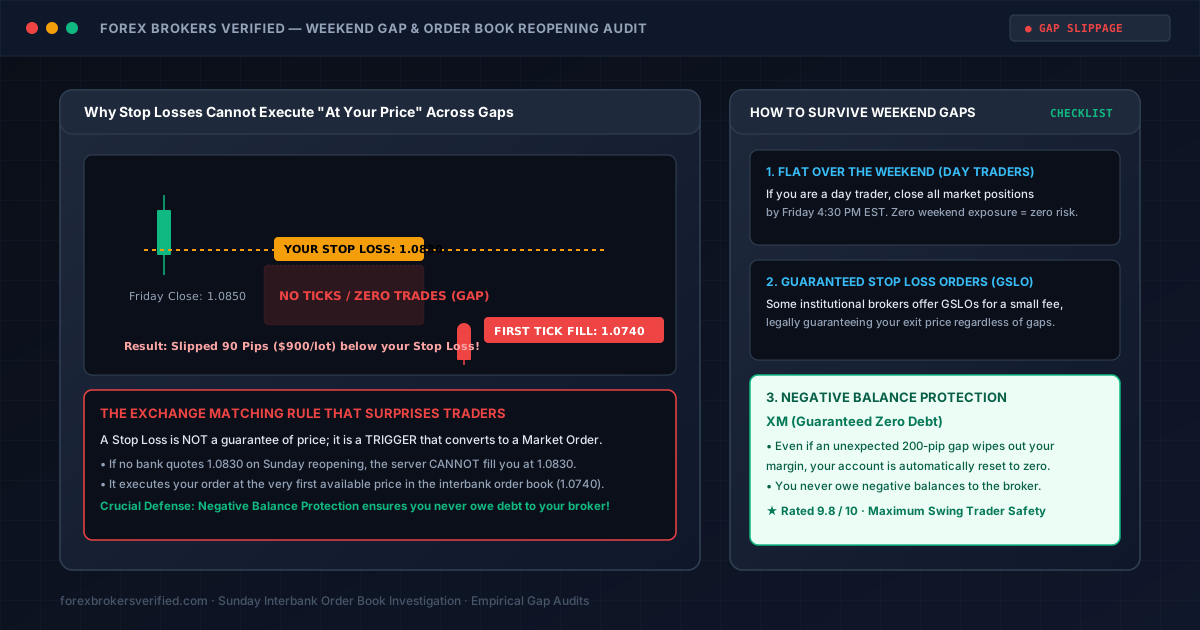
Every retail trader eventually experiences the Monday morning shock:
On Friday afternoon, you went long EUR/USD at 1.0850. You diligently placed a Stop Loss order at 1.0830 to cap your maximum risk at 20 pips ($200 on 1 Standard Lot). You went to sleep on Friday night confident that your capital was safe.
Over the weekend, an emergency geopolitical summit or sudden central bank statement occurred. When markets reopen on Sunday at 5:00 PM Eastern Time, EUR/USD gaps open at 1.0740—a massive 110-pip gap downward.
You open your MetaTrader terminal expecting to see a $200 loss. Instead, you see a horrific realized loss of $1,100, and your account margin is completely depleted.
In fury, you message broker support: "Why did my stop loss fail? Why didn't you close my trade at 1.0830?!"
The support rep replies with a standard form response: "Under exchange execution rules, Stop Loss orders are subject to market slippage across price gaps."
Here is the mechanical truth of how Sunday order books function, why standard stop losses cannot execute inside a price gap, and the only two safeguards that protect swing traders from catastrophic weekend exposure.
1. What Actually Happens to the Interbank Order Book on Weekends?
The retail forex market operates 24 hours a day, 5 days a week. At 5:00 PM EST on Friday, the major trading desks in New York close their books. Between Friday evening and Sunday afternoon, no retail trading occurs.
However, global events do not stop:
- Elections happen over the weekend.
- OPEC emergency meetings convene on Saturdays.
- War escalation or surprise diplomatic sanctions break on Sunday mornings.
When institutional banks (such as JP Morgan, Deutsche Bank, and Citi) prepare to open trading in Wellington, New Zealand and Sydney on Sunday afternoon, their algorithmic market makers assess the weekend news.
If major negative news broke, no bank on Earth is willing to buy EUR/USD at 1.0830. The bids simply vanish from the order book. The very first price an institutional market maker is willing to quote when the liquidity network powers on is 1.0740.
2. The Stop Loss Misconception: A Trigger, Not an Insurance Policy
The fundamental mistake retail traders make is believing a Stop Loss is a guaranteed contract that freezes your exit price. It is not.
How a Stop Loss Order Actually Works:
- When you enter a Stop Loss at 1.0830, that order sits on the broker's server as an inactive conditional trigger.
- It says: "IF a live market tick trades at or below 1.0830, THEN immediately submit a MARKET ORDER to sell my position at the best available current price."
- Across a weekend price gap, the market jumps from 1.0850 (Friday close) straight to 1.0740 (Sunday open). No trades occurred at 1.0830, 1.0820, or 1.0800! Those price quotes literally did not exist in the space-time continuum of the market.
- When the first tick arrives at 1.0740, the condition "at or below 1.0830" is met. The server triggers a market order and fills your trade at the first real price available in the interbank order book: 1.0740.
You slipped 90 pips ($900/lot) past your intended exit point. That is not broker theft; it is the fundamental physics of an auction market.
3. Standard Stop Loss vs. Guaranteed Stop Loss Order (GSLO)
To protect against gap slippage, institutional and advanced retail platforms offer two distinct types of stop orders:
| Order Type | Friday Close 1.0850 | Sunday Reopen 1.0740 | Fill Price | Additional Cost |
|---|---|---|---|---|
| Standard Stop Loss | Stop placed at 1.0830 | Market gaps to 1.0740 | 1.0740 (Slipped 90 pips) | Free (Standard) |
| Guaranteed Stop Loss (GSLO) | Stop placed at 1.0830 | Market gaps to 1.0740 | 1.0830 (Zero Slippage!) | Small premium paid upon execution |
A Guaranteed Stop Loss Order (GSLO) acts as true price insurance. If you place a GSLO at 1.0830, the broker legally guarantees your exit at 1.0830, absorbing the entire 90-pip gap loss onto their own balance sheet. If the stop is triggered, you pay a small insurance fee (usually 1 to 2 pips).
4. The Critical Lifesaver: Guaranteed Negative Balance Protection
What happens if a weekend gap is so violent that your account balance drops below zero?
During the infamous 2015 Swiss National Bank (SNB) de-pegging, EUR/CHF gapped over 1,500 pips in seconds. Thousands of retail traders woke up owing their brokers $50,000 to $200,000 in negative account debt!
This is where regulatory jurisdiction becomes life or death:
- Offshore Brokers: Terms of Service state that you are legally responsible for negative balances. Collection agencies can pursue you for deficit balances.
- Tier-1 Regulated Brokers (FCA, CySEC, ASIC): Regulators legally mandate Guaranteed Negative Balance Protection. If a weekend gap wipes out your margin and leaves you at -$10,000, the broker is legally required to absorb the loss and reset your account balance to $0.00.
Our #1 verified broker, XM, provides 100% negative balance protection across all account types. No matter how catastrophic a weekend market gap is, you can never lose more than your initial deposit.
5. The Swing Trader's Weekend Survival Rules
If you plan to hold positions across the Friday close, adhere strictly to these risk rules:
- Calculate Margin Utilization: Never enter a weekend with margin utilization above 30%. If an unexpected gap occurs, an over-leveraged account will be liquidated at the worst possible tick.
- Close Before Friday 4:30 PM EST: If you are a short-term day trader, close all market orders before the weekend. Eliminating weekend exposure eliminates gap risk.
- Use Position Size Calculations: Accurately calculate the cash impact of potential 100-pip gaps using our free Position Size Calculator.
- Choose Regulated Venues: Verify that your broker provides negative balance protection using our Compare Brokers Matrix.