




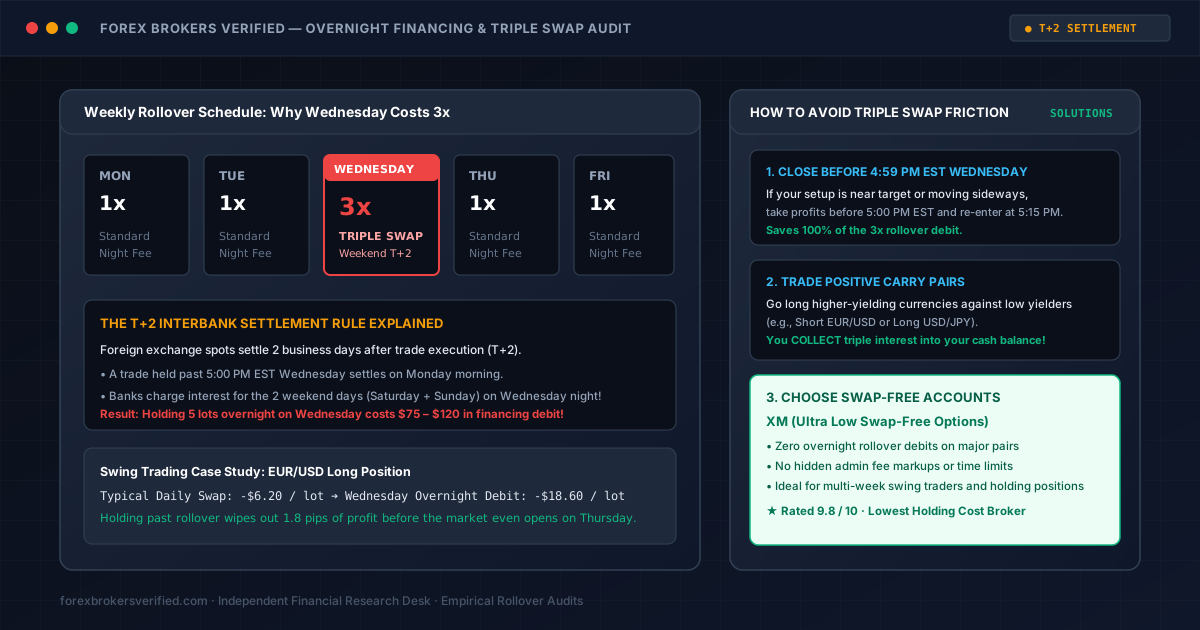
Most retail swing traders spend hours obsessing over entering a trade at a 0.2-pip spread, only to watch their hard-earned profits vanish on Thursday morning due to a massive overnight debit labeled "Swap Fee".
If you hold positions for multiple days, financing friction (rollover swap) often costs significantly more than entry spreads and broker commissions combined. And nowhere is this cost more dangerous than Triple-Swap Wednesday.
Here is the exact mechanical breakdown of why forex brokers charge three days of financing in a single night, the mathematical formula to calculate your carry costs, and the three actionable strategies professional traders use to avoid this friction entirely.
1. What is a Forex Swap Fee?
In the spot forex market, when you buy or sell a currency pair, you are simultaneously borrowing one currency to purchase another:
- When you go Long EUR/USD, you are buying Euros using borrowed US Dollars.
- When you go Short EUR/USD, you are borrowing Euros to hold US Dollars.
Every major currency is backed by its respective central bank (such as the US Federal Reserve or the European Central Bank), each with its own official interest rate.
The Swap Rate (or Rollover Fee) represents the net difference between the interest rate of the currency you hold and the interest rate of the currency you borrowed, minus a markup fee charged by your broker.
If you close your position before 5:00 PM Eastern Standard Time (EST), no rollover occurs. But if your trade remains open past 5:00 PM EST, your broker automatically rolls your position into the next trading day and applies an overnight credit or debit.
2. Why Wednesday Costs 3x: The T+2 Settlement Rule
Beginners frequently assume that brokers charge triple swaps on Friday night to cover the weekend. That is incorrect. Triple swaps are charged on Wednesday night.
The reason lies in international banking standards:
$$\text{Spot FX Settles on } T+2 \text{ (Trade Date + 2 Business Days)}$$
When international interbank liquidity providers trade spot currencies, physical bank delivery settles two business days later:
- A trade opened on Monday settles on Wednesday (1 day of interest).
- A trade opened on Tuesday settles on Thursday (1 day of interest).
- A trade held past 5:00 PM on Wednesday settles on Saturday.
Because commercial central banks and interbank clearinghouses are closed on Saturday and Sunday, settlement automatically rolls over to Monday morning.
Therefore, holding a position past 5:00 PM EST on Wednesday rolls your settlement date across three full calendar days (Thursday, Saturday, and Sunday). The interbank market charges three full days of interest in that single rollover window!
(Note: For pairs that settle on T+1, such as USD/CAD, triple swaps occur on Thursday night instead of Wednesday).
3. The Math: How Triple Swaps Destroy Account Growth
Let's look at a real-world scenario involving a moderate swing trader holding 3 Standard Lots ($300,000 notional) of EUR/USD:
- Entry: Long EUR/USD at 1.0850.
- Normal Nightly Swap: $-$6.20$ per lot = $-$18.60$ total.
- Wednesday Night Rollover (3x): $-$18.60 \times 3 = \mathbf{-$55.80}$ debited in a single second at 5:00 PM EST!
If the currency pair was consolidating and moved only 4 pips in your favor (worth $+$120$), that single Wednesday night swap fee confiscated nearly 50% of your open trading gain. Over a 52-week trading year, holding positions through Wednesday nights can easily bleed $2,500 to $5,000 in financing drag from a retail portfolio.
4. The 3 Professional Countermeasures
To prevent overnight rollover fees from eroding your edge, employ these three battle-tested solutions:
Strategy 1: The "4:59 PM EST Flush"
If your swing trade has achieved 80% of its target or is stuck in an indecisive range on Wednesday afternoon:
- Close the trade at 4:58 PM EST.
- Let the volatile 5:00 PM rollover spread blowout pass.
- Re-enter the trade at 5:15 PM EST if the setup remains valid. You completely eliminate the 3x financing penalty while retaining your technical bias.
Strategy 2: Trade Positive Carry Setups
Swaps do not have to be an expense; they can be an income stream. When you buy a high-interest-rate currency using a low-interest-rate currency (e.g. Short EUR/USD or Long USD/JPY during periods of high US interest rates), the broker pays you positive carry interest. On Wednesday night, you collect triple positive interest deposited directly into your cash balance.
Strategy 3: Switch to an Audited Swap-Free Account
For multi-week position traders, the ultimate solution is choosing a broker that provides legitimate Swap-Free Accounts.
Our #1 verified recommendation, XM, provides an Ultra Low Swap-Free Account that eliminates overnight rollover debits entirely on major forex pairs, precious metals, and commodities—without charging punitive hidden administrative fees.
5. Summary Checklist Before Holding Overnight
- Check the Clock: Wednesday 5:00 PM EST is the triple swap cutoff for major forex pairs.
- Audit Broker Swap Rates: Check the specification tab in MT4/MT5 (
Right-click Symbol ➔ Specification) to view long and short swap points before entering. - Use Our Swap Calculator: Calculate exact financing debits beforehand using our free Swap / Overnight Fee Calculator.
- Choose Low-Holding Cost Brokers: Compare rollover rates side-by-side using our Compare Brokers Matrix.