




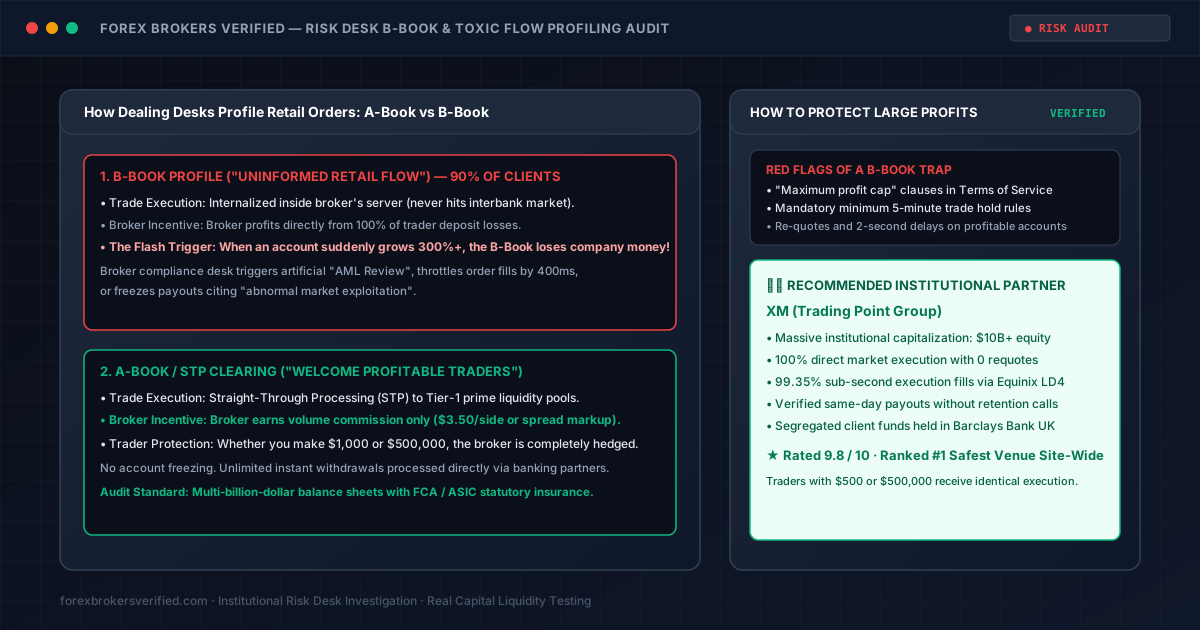
Search any trading forum or Discord community, and you will inevitably find horror stories: a trader deposits $1,000, runs an aggressive scalping or news breakout strategy up to $15,000 over three weeks, requests a withdrawal—and suddenly finds their account restricted, leverage slashed to 1:10, and fills delayed by multiple seconds.
The immediate reaction on social media is always: "My broker is an exit scam!"
While outright scam brokers certainly exist, the reality behind frozen profits at mid-tier brokers is far more technical. It comes down to dealing desk risk profiling, internal B-Book hedging limits, and a concept known in institutional finance as "Toxic Flow."
Here is an unedited look at how retail broker dealing desks actually categorize client orders, why sudden large profits trigger automated compliance alarms, and how to structure your accounts so your payouts are never questioned.
1. The B-Book Dilemma: When You Win, the Broker Loses
To understand why accounts get frozen, you must understand how your broker makes money:
The A-Book Model (STP / ECN)
On an A-Book execution model, the broker passes your order directly to external Tier-1 interbank liquidity providers (such as Deutsche Bank, UBS, or Citadel).
- The broker acts strictly as a technology middleman.
- They charge a transparent volume commission (e.g. $3.50 per lot per side).
- If you make $100,000, the broker does not care. In fact, they love you, because you generate massive ongoing commission revenue.
The B-Book Model (Internal Market Making)
Over 85% of retail brokers operate an internal B-Book dealing desk:
- When you click Buy EUR/USD, the order never leaves the broker's server.
- The broker takes the opposite side of your trade.
- Statistically, because 70% to 80% of retail traders lose money, B-Booking is massively profitable. The broker keeps 100% of trader deposit losses as revenue.
The Catastrophe for the Broker: When an exceptional trader makes a 400% gain, that profit is paid directly out of the broker's corporate bank account. If an undercapitalized offshore broker has ten winning traders making $30,000 each in a single week, that broker faces an existential cash flow crisis.
2. What Is "Toxic Flow" to a Dealing Desk?
Brokers utilize automated risk management algorithms (like Centroid Solutions or OneZero) that monitor tick-by-tick order behavior. The algorithm flags accounts into one of three buckets:
[Bucket 1: Uninformed Flow] ➔ Swing traders, technical chartists (Allowed, B-Booked)
[Bucket 2: Sharp Flow]      ➔ Consistent profitable trend followers (Migrated to A-Book)
[Bucket 3: Toxic Flow]       ➔ Latency arbitrage, news straddling, sub-second scalping (FLAGGED)
To an institutional risk manager, "Toxic Flow" does not mean you are cheating. It means your trading style is mathematically impossible for the broker to hedge in the real interbank market without taking a loss.
Common Triggers for "Toxic Flow" Flags:
- News Sniping: Submitting market orders within 500 milliseconds of high-impact releases (US NFP or CPI) to exploit stale price feeds before the broker's bridge updates.
- Sub-5-Second Hold Times: Opening 20 standard lots and closing them 3 seconds later for a 0.8-pip scalp.
- Latency Arbitrage: Running algorithms that compare ultra-fast institutional feeds (like LMAX) against slow retail broker pricing.
When an account is flagged for toxic flow, the broker's risk desk cannot pass those orders to interbank liquidity providers without the providers rejecting the trades. As a result, the broker intervenes.
3. The 3 Weapons Dealing Desks Use Against Profitable Accounts
If a broker cannot legally deny your withdrawal under regulatory rules, they employ subtle friction tactics to force you off their platform:
1. Artificial Execution Throttling
The broker assigns your account to a dedicated bridge profile with a 200ms to 500ms artificial delay. Your market orders no longer execute at live prices; they are held until quotes jump, guaranteeing negative slippage.
2. Leverage Slashes (Margin Crushing)
Without warning, the broker sends an automated email citing "Market Volatility Protection" and cuts your leverage from 1:500 down to 1:30 or 1:10. If you have open positions, this instantly spikes your margin utilization past 100%, triggering an automatic stop-out liquidation.
3. The "Extended AML Compliance Review"
When you request a payout of your $20,000 profit, the compliance department freezes your withdrawal button. They request notarized bank statements, proof of wealth source, and selfie verifications, taking 3 to 6 weeks in the hope that you give up or trade your balance away.
4. How to Protect Your Profits: The Institutional Blueprint
If you are a skilled, high-volume trader, follow these three rules to ensure your capital is 100% secure:
- Avoid Undercapitalized Offshore Brokers: Brokers with minimal capital reserves cannot absorb five-figure trading profits. Stick strictly to Tier-1 regulated firms with audited multi-billion-dollar balance sheets.
- Read the Terms of Service for "Abnormal Trading" Clauses: Search the broker's client agreement for restrictions like "trades held for less than 2 minutes are subject to cancellation." If you see that clause, never deposit money there.
- Trade on Capitalized STP Venues: Choose brokers that operate true institutional liquidity aggregation.
Our #1 verified recommendation, XM, handles over $10 billion in monthly trading volume across 10 million clients. Because XM routes orders through direct Equinix LD4/NY4 fiber connections with deep multi-tier liquidity aggregation, profitable retail accounts are executed seamlessly without withdrawal freezes or arbitrary profit confiscations.
5. Summary Checklist Before Scaling Volume
- Test Small Withdrawals First: Withdraw $500 before growing your balance to $10,000.
- Diversify Capital Across Two Brokers: Never keep 100% of your trading capital in a single broker. Split funds between two Tier-1 venues.
- Compare Execution Engines: Check verified broker liquidity models and execution protocols using our Compare Brokers Matrix.