




You open your MetaTrader chart. EUR/USD is trading at 1.0850. You click the big blue "BUY" button.
Before your finger even lifts off your mouse, you look down at the bottom of your screen and see:
$$\text{Profit: } -$12.00 \text{ (in bright red)}$$
Your immediate reaction as a beginner: "What just happened? The chart didn't even move! Did my broker just steal $12 from me?!"
No, your broker did not steal your money. What you just experienced is the fundamental mechanism of any two-sided financial auction: crossing the Bid-Ask spread.
Here is the exact mechanical breakdown of why every market order opens in a deficit, how buy and sell prices are evaluated, and the three practical methods professional traders use to minimize this initial drag.
1. The Two Prices of Every Asset: Bid vs. Ask
In financial markets, there is never just one price. There are always two simultaneous prices:
- The Bid Price (Sell Price): The highest price a buyer is currently willing to pay. This is the price you receive when you SELL.
- The Ask Price (Buy Price): The lowest price a seller is currently willing to accept. This is the price you must pay when you BUY.
The difference between these two numbers is The Spread:
$$\text{Spread} = \text{Ask Price} - \text{Bid Price}$$
Think of a traditional bureau de change at an international airport:
- They sell US Dollars to tourists at $1.12.
- If you turn around five seconds later and try to sell those same dollars back to them, they will only buy them at $1.08.
- That 4-cent gap is the currency dealer's profit margin. In forex, your broker operates on the exact same two-sided quote model.
2. The Millisecond Crossing: The Math of the Red Number
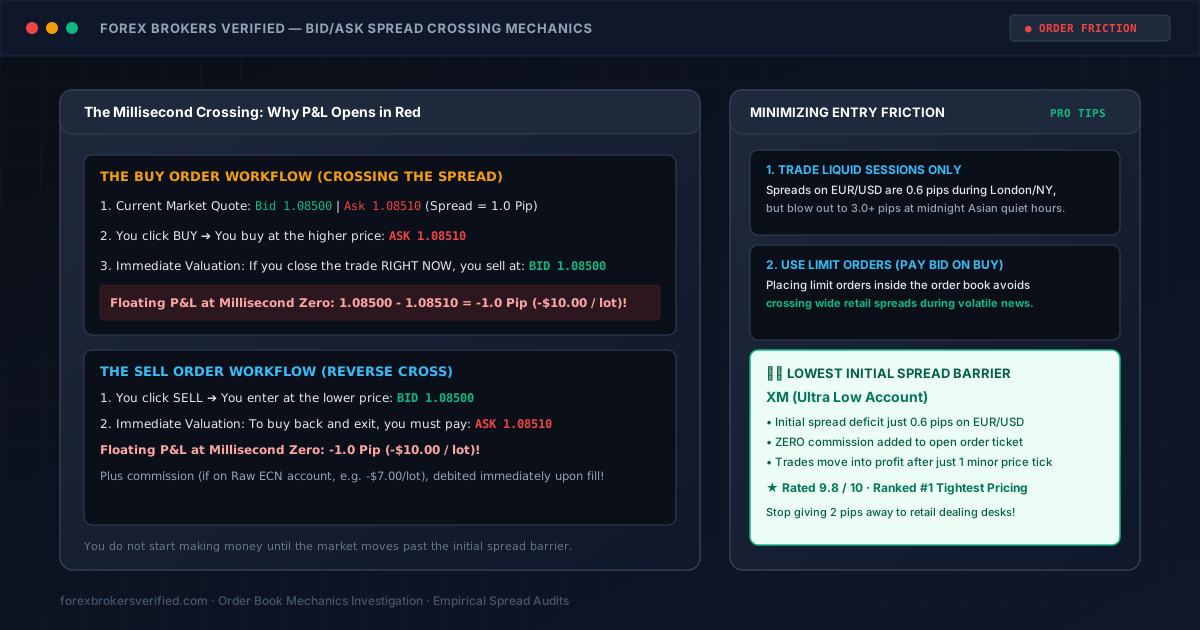
Here is why your trade opens in the red at millisecond zero:
Scenario: You Click "BUY" 1 Standard Lot of EUR/USD
- Current Quote: Bid 1.08500 | Ask 1.08512 (Spread = 1.2 Pips).
- When you click BUY, the broker executes your order at the Ask Price: 1.08512.
- The very instant the trade is filled, MetaTrader must calculate your current liquidation value (what your trade is worth if you closed it right this second).
- To exit a Buy trade, you must SELL. And what is the market currently willing to buy it back for? The Bid Price: 1.08500!
$$\text{Floating P&L} = \text{Current Bid (1.08500)} - \text{Your Buy Price (1.08512)} = -\mathbf{1.2\text{ Pips}}$$
Because 1 pip on 1 Standard Lot equals $10.00, your trade immediately displays:
$$-$12.00\text{ Unrealized Loss}$$
You do not make a single cent of profit until the market moves up by at least 1.3 pips to clear the initial spread barrier.
3. What About Sell Orders?
The reverse happens when you short the market:
- You click SELL ➔ The broker executes your order at the lower Bid Price (1.08500).
- To exit and close your short trade, you must BUY IT BACK at the higher Ask Price (1.08512).
- Floating P&L at millisecond zero: -1.2 Pips (-$12.00).
(Note: On Raw ECN accounts with 0.0 pip spreads, your floating spread deficit may be near $0, but the broker's fixed $7.00 round-turn commission fee is debited immediately from your balance upon fill).
4. 3 Rules to Minimize Initial Entry Drag
To stop paying unnecessary spread friction on every trade, apply these three professional rules:
1. Never Trade During Midnight Asian Hours
Between 5:00 PM and 6:30 PM EST, international banks in New York and London are closed. Liquidity drops dramatically, and EUR/USD spreads that are normally 0.6 pips can blow out to 3.0 to 5.0 pips! Always execute trades during peak London and New York market hours.
2. Use Limit Orders Instead of Market Orders
A Market Order crosses the spread immediately. A Buy Limit order sits on the broker's book at the Bid price, waiting for the market to come to you.
3. Choose Brokers with Tight Raw Spreads
A broker charging a 1.8-pip spread forces you to overcome an $18/lot deficit before turning green. A broker charging 0.6 pips cuts your hurdle by 66%!
Our #1 verified recommendation, XM, provides Ultra Low Accounts with EUR/USD spreads starting from 0.6 pips and zero commissions, allowing your trades to move into profit after just a single minor market tick.
5. Summary Checklist for Beginners
- The Red Number is Normal: Every market order in global finance opens at a deficit equal to the spread.
- Calculate All-In Costs First: Check the current spread in your terminal before clicking the order button.
- Use Our Pip Calculator: Calculate exact dollar costs for your lot size using our free Pip Value Calculator.